
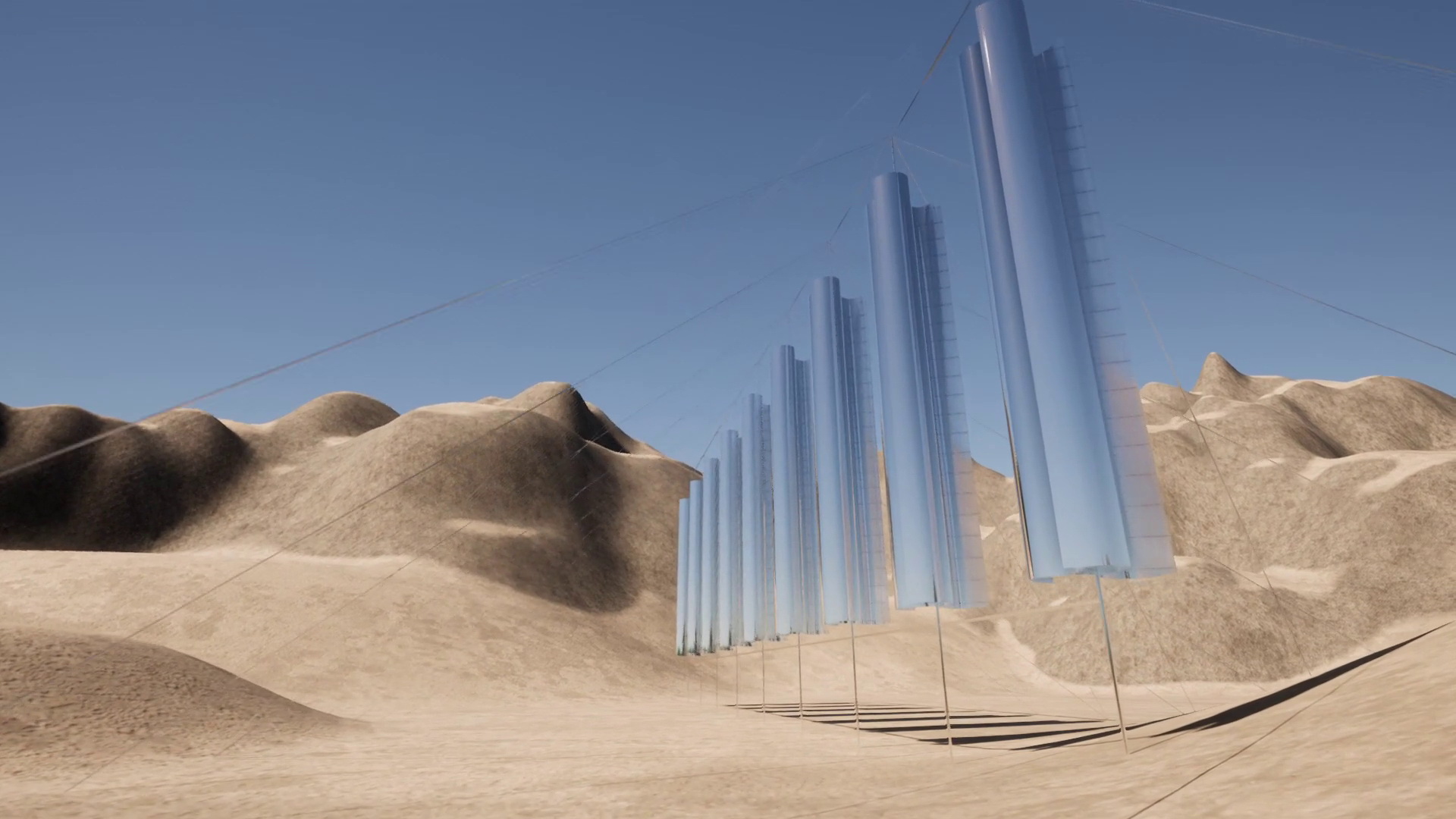
Thin metal sheets and thin cables. Sent from Earth in the beginning … then manufactured on Mars. This design can “grab” the wind quite well. Almost no materials needed. Lack of “gravity” and extreme winds would let us go with even a taller … and lighter design than on this example.
Piling down metal bars in the ground. The thin metal blades are shaped this way with metal cables. Robots could assemble it without any problem. Valleys and hilltops would be a great choice (be it at the Poles or at the Equator).
Solar panels positioned on/within the rotating blades would remain clean. Dust free. Solutions like this could decentralize our energy demands. In case of a disaster … 99.999% remains in a flawless state. Hundreds of firms could make, develop, sell, compete providing energy, water, minerals as well. This kind of competition would be promising for the end consumer and for the economy as well.
Because the infrastructure (and 3d roads) are underground … there is plenty of space to move around freely on the surface. We could position city’s everywhere. Especially near mountains … to harness the wind. If we find the right minerals needed to feed plants, constant winds, water sources we are ready to build a new settlement.
Pressure difference could provide us limitless and predictable energy. Air finds the shortest route to equalize pressure. Compared to Earth: on Mars the day and night temperature fluctuation is a lot bigger. (like here in the Sahara). At mountain side that intensifies even more.
Hot and cold air in constant motion. Imagine not just windmills within valleys … but digging an actual tunnel threw a mountain as well.
Air would act like a liquid. Most of the air would want to equalize pressure between 2 valleys. A constant, predictable and low-cost energy source. A wind turbine. A few robots could clean up the system periodically to keep it clean of dust.
The tunnel can’t be really long. The inside temperatures could mess up the phenomena. (however, we might tap into that as well). We will need tall … but a narrow chain of mountains running parallel with the equator.
Technology’s to store energy.
In Switzerland they compress air in a tunnel. When electricity is needed … they just start to release the compressed air. Running up and down weights on a mountain slope could achieve similar results.
On Mars the cheapest and simplest version would be simply piling/drilling metal bars in the ground. Building a simplified “ski lift” with rocks on it. Sand storms, temperature differences will not affect the structures to much. Kinetic flywheels could be an option for the indoors.