The Cheetah’s Fridge: Bypassing the Chemical Battery Bottleneck with Hydronic Thermal Mass
The Predator’s Logic: The Flaw in Modern Solar Storage
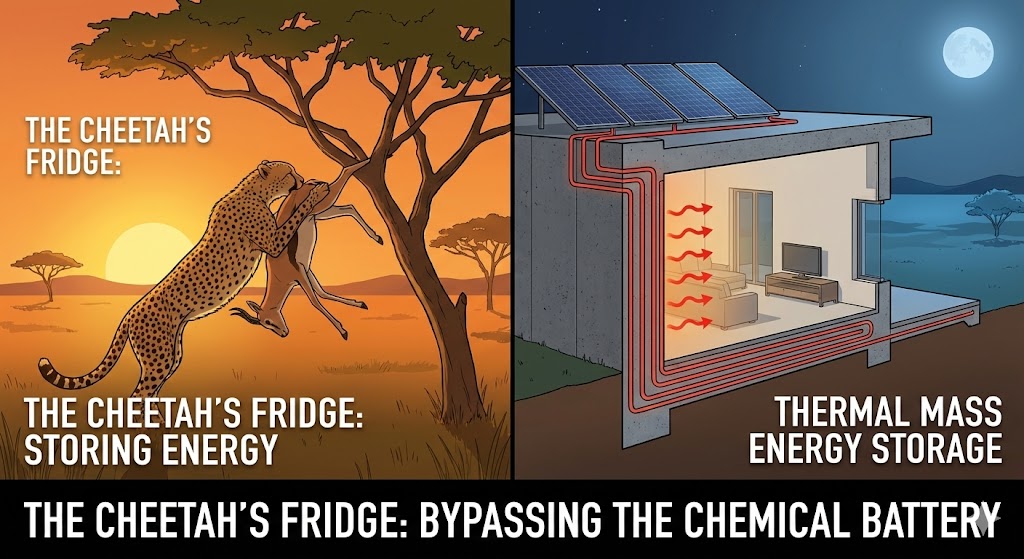
In the wild, a cheetah expends a massive amount of energy to secure its prey during the heat of the day. But the cheetah doesn’t eat the entire kill at once. To protect its asset from scavengers and preserve it for the night, it drags the meat high into a tree. It stores the energy when it is abundant, to consume it when it is scarce.
The modern renewable energy sector has completely forgotten this basic predator’s logic.
Today, we generate massive amounts of cheap solar energy during the day. But when the sun goes down and temperatures drop, we face a massive bottleneck: storage. The real estate and energy industries have convinced themselves that the only way to store this daytime solar energy is by buying highly expensive, rapidly degrading, chemical lithium-ion batteries (like the Tesla Powerwall).
This is a multi-billion-dollar mistake. Maverick Mansions has engineered a vastly superior, infinitely cheaper storage mechanism: The Cheetah’s Fridge.
The HVAC Delusion: Why Heating Air is Mathematically Flawed
Traditional Heating, Ventilation, and Air Conditioning (HVAC) systems are built on a flawed premise: they heat the air.
In physics, air has virtually zero density and zero mass. Because it has no mass, it has no thermal momentum. The absolute second your traditional heater turns off, the air cools down, and the house becomes freezing. To compensate, the heater must cycle on and off constantly, burning massive amounts of energy.
If you are using expensive lithium batteries to power a traditional HVAC system through the night, you are effectively burning cash to heat nothing but empty space.
The Maverick Solution: Hydronic Solar Arbitrage
Instead of buying a $10,000 chemical battery, Maverick Mansions uses the literal skeleton of the house as a biological battery.
Here is the exact first-principle physics of how “The Cheetah’s Fridge” works:
The Daytime Capture: During the peak hours of the day, when solar panels are over-producing free electricity, we do not send that energy to a chemical battery. Instead, we use it to power a simple, highly efficient electric water heater.
Charging the Thermal Flywheel: This hot water is circulated via a small pump through a network of pipes embedded directly inside the heavy, high-mass inner walls of the home (concrete, stone, or rammed earth).
The Momentum of Mass: Unlike air, heavy walls have immense Specific Heat Capacity (thermal mass). It takes hours for the walls to absorb this heat. It acts exactly like a massive freight train: it takes a lot of energy to get it moving, but once it is at top speed, it takes hours to slow down. The walls slowly, steadily heat up by just a few degrees.
The Nighttime Release (The Fridge): By the time the sun goes down and the solar panels stop producing, the walls are fully “charged.” The pump turns off. For the entire night, the heavy walls act as a massive thermal radiator, gently releasing that stored kinetic energy into the living space.
The Economic Verdict: Physics Beats Chemicals
This is the ultimate form of energy arbitrage. We are taking free energy when it is abundant and storing it in materials we already had to buy to build the house.
A lithium battery degrades over 10 years, requires toxic mining, and costs a fortune. A thermal mass wall lasts for 1,000 years, costs pennies on the dollar to outfit with PEX tubing, and offers an infinite cycle life with zero degradation.
We do not need to invent more expensive batteries to survive the winter. We just need to remember the cheetah, respect the laws of thermodynamics, and let the sheer mass of the house do the heavy lifting.