The Dimetrodon’s Sail: Strategic Thermal Bridging and Decoupled Hydronics
The Structural Parasite: Unintentional Thermal Bleed
The modern construction industry bleeds money and energy through a catastrophic architectural oversight known as thermal bridging.
Standard development practices routinely pour external concrete slabs, sidewalks, and patios directly against the primary foundation of the home. Because concrete and steel are highly conductive materials, this creates an unbroken thermal bridge between the interior of the home and the exterior environment. In the winter, this external concrete acts as a parasitic fin, rapidly siphoning expensive, mechanically generated heat out of the house and radiating it into the frozen ground. In the summer, the sun-baked patio pumps raw thermal energy directly into the home’s interior, overwhelming the air conditioning system.
You are effectively paying the utility company to heat and cool your front yard.
The Maverick Solution: The Biomimetic Paradigm
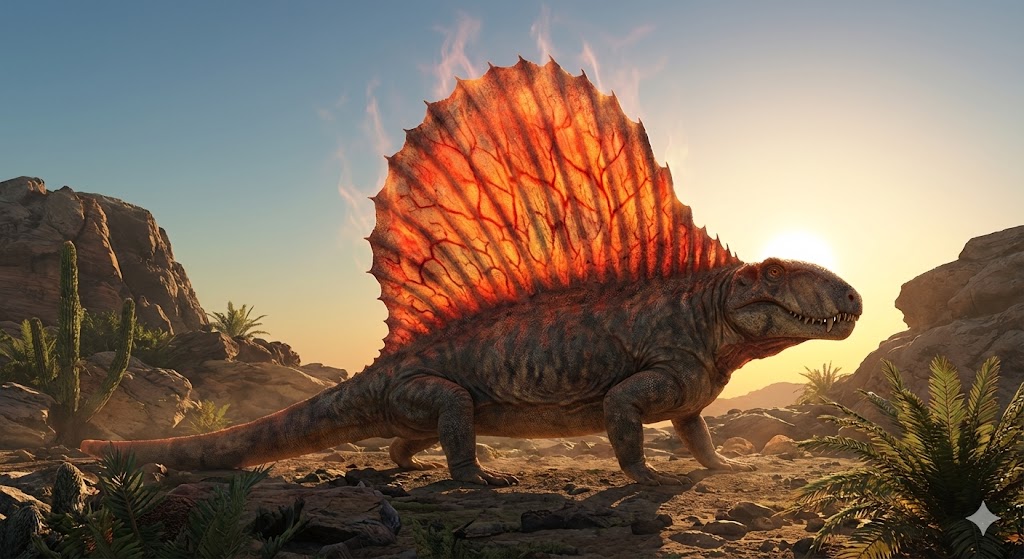
To solve this, Maverick Mansions looks 295 million years into the past to the apex predator of the Permian period: the Dimetrodon.
The Dimetrodon possessed a massive, highly vascularized sail on its back. In the freezing dawn, it would position this sail to capture solar radiation, rapidly heating its blood and circulating it into its heavy core mass. It separated its “energy collection” from its “core,” allowing it to reach peak kinetic performance while its prey remained immobilized by the cold.
Maverick Mansions applies this exact biomimetic principle to our eco-home engineering, utilizing a strict two-phase protocol: Defensive Decoupling and Offensive Energy Capture.
Phase 1: Defensive Decoupling (The Thermal Break)
We completely sever the parasitic connection between the house and the environment. Maverick Mansions mandates strict thermal breaks. No external concrete sidewalk, patio, or structural steel is ever allowed to physically touch the main thermal envelope of the house. We insert rigid, high-performance insulation barriers between the foundation and any external hardscaping. This mathematically traps the energy inside the house, instantly reducing HVAC operational costs by up to 30%.
Phase 2: The Synthetic Sail (Offensive Thermal Harvesting)
Once the house is thermally sealed, we intentionally build our own “Dimetrodon Sails”—decoupled, highly conductive loops designed to aggressively harvest free environmental energy and pump it into the home’s thermal mass (The Cheetah’s Fridge).
Depending on the geographical context, these synthetic sails take various forms:
The Subterranean Loop: We bury closed-loop hydronic pipes deep in the earth where the temperature remains a constant 55°F (12°C). In the blazing summer, water circulates through these pipes, dumps the home’s excess heat into the cool earth, and returns naturally chilled water to the house for zero-cost radiant cooling.
The Aquatic Heat Exchanger: For properties near lakes or ponds, we submerge the thermal loops underwater. Water is a vastly superior thermal conductor compared to air, allowing us to harvest massive amounts of ambient cooling or base-level heating with near-zero electrical input.
The Greenhouse Solar Collector: In sub-zero climates, we run the hydronic loops through an attached, sun-baked greenhouse. The greenhouse acts as the literal “sail,” capturing extreme solar radiation and pumping that boiling water directly into the home’s high-mass interior walls.
The Economic Verdict: Engineering the Apex Asset
To an institutional investor or venture capitalist, energy efficiency is not an environmental buzzword; it is a metric of asset valuation.
Traditional architecture builds a leaky box and relies on expensive, grid-dependent mechanics to constantly refill it with heat and air conditioning. By physically severing parasitic thermal bridges and engineering biomimetic “sails” to harvest free geothermal and solar energy, Maverick Mansions creates an autonomous, apex-level asset. We drastically lower initial capital expenditures (CAPEX) on oversized HVAC equipment while permanently driving operational expenditures (OPEX) to zero.